
School of Failure
The School of Failure
Let’s talk about school and failure.
Learn To Fail : Fail To Learn.
Mirror, mirror on the wall… will I fail, or will we all?
As a child of a teacher, I talked a lot about school. What’s interesting about it, to me, is the angle I took. I didn’t speak from a child’s perspective or a teacher’s perspective, but from some undefined third-party standpoint. I invented a ton of situations that my mother found hilarious and drew them. I often see myself as a lightweight something sitting in a tree, halfway hidden by branches and leaves, watching.
Fast forward to today. Having gone through school three times - as a child, and then through my children — I carry a deep, persistent feeling of having failed them. I feel incurably stupid and guilty for having chosen this country for their education: I trusted the love I had for it. I didn’t even research this one crucial point, thinking it couldn’t be worse than what I had left behind. I assumed that, over decades, things would have evolved. That it would be okay.
It wasn’t.
Such a fool I was.
What hurts most is not just disappointment — it’s the impact. School didn’t simply “not work” for my child. It actively damaged something extraordinary: their beauty, their purity, their natural way of approaching the world. That rare ability to fail to learn — to resist absorbing things that didn’t make sense to them, to question, to remain open — was treated like a defect. Worse, like a crime.
And it was punished.
That punishment didn’t stay within school walls. It spilled into our home, into our relationships, into my professional life. It created tensions, exhaustion, consequences I could never have imagined. Some of those wounds haven’t healed to this day.
For that, I want to apologize.
To my child, first. And to everyone who was affected by the ripple effects of choices I made with trust, but without enough awareness.
I see so many schools popping up now, here and there — each serving a purpose, mostly accessible to those with stable financial means.
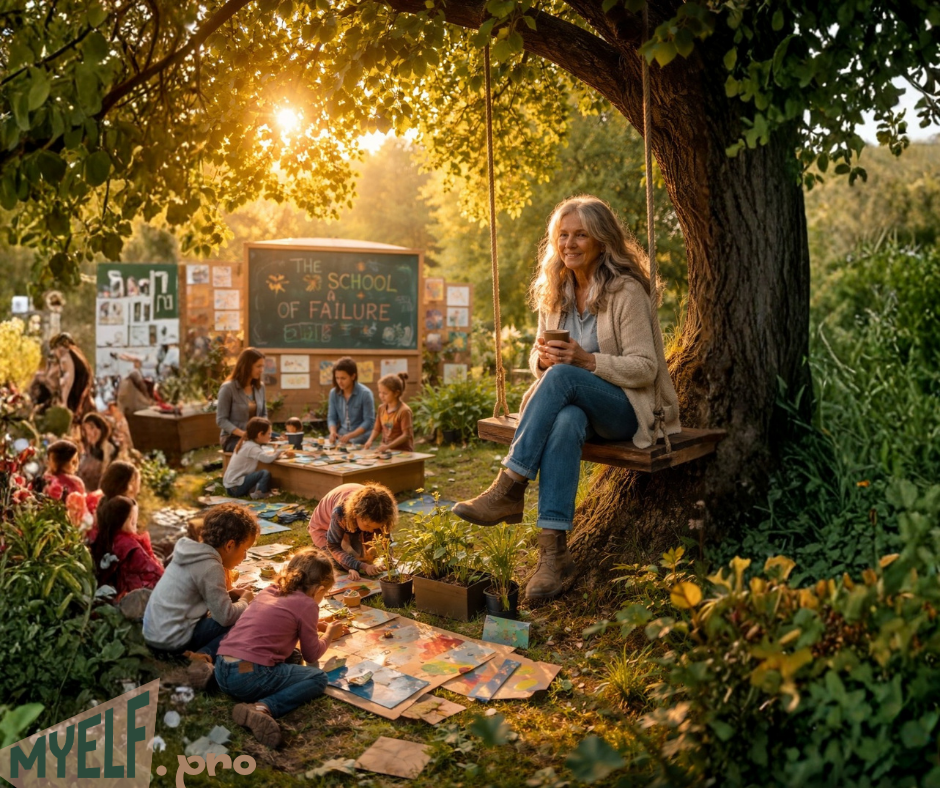
© 2026 MyElf pro - First attempt by an AI at creating a visual for this plot, based on an incomplete prompt — not too bad.
I used to fantasize about opening my own school, because I couldn’t find what I was looking for at a price I could afford, in the place I had chosen to live in. But thinking about it for more than five seconds was exhausting : the input-output ratio wasn’t right, and that’s not just because of paperwork.
France has many challenges in education. It has softened over the years, for sure, but it can still feel rigid and chaotic. Public schools often come across as strict, inflexible, and disconnected and some teachers as frustrated, ignorant or arrogant. Private schools are either religious or financially out of reach for average families, especially with multiple children. Homeschooling is complex, often isolating, and mostly incompatible with working parents. And staying “within the system” remains tied to opportunity: selective, conditional, not truly open to everyone, even if they tick all the boxes.
If I had the chance to build a school, it would be the School of Failure. 5 years back in time, I would have named it The School of A’s (like I, A., as a school, am taking underperforming students to success and being themselves), but the real project is failure, not elite or success first.
We wouldn’t measure success with grades, but with the number of failed attempts. We would celebrate them. Students would learn to treat ‘no’ as a next option, try again in a different way, persevere, and not shy away from others staring at them.
I’d hire two hypocrites — an older man and a younger woman — to navigate administration and charm hierarchical systems, to open doors for all the lovely, joyful, resistant, respectful, curious, colorful, pure, and diverse people this school would shape.
Our pupils would make a mess. A glorious one. Because first, you learn to create (a mess). Later, you learn to structure. And eventually, you transform chaos into something meaningful and socially acceptable.
They would be encouraged to push boundaries, on paper, in play, in thought, because that’s how they learn what they want and to stand up for themselves.
They would learn to be themselves. And everyone would learn to accept them.
Together — students, staff, myself — we would learn to understand others, including their flaws and failures. And that would be the reason we appreciate them so honestly. Failure wouldn’t just be accepted. It would be owned.
They would leave school rich and robust, in resilience, grounded, loved, and capable of pursuing whatever they want — without hiding, because they would know who they are and have learned to be proud of themselves and that’s wonderful, because now that they know how to fail and who is failure, they don’t need to be afraid or ashamed and can move on to contributing, doing good, moving forward, and succeeding.
Companies will be on waiting lists for hires and would start paying extra rewards for “proven smart failure resolution” — people who tried, got it wrong, and found better ways.
Within five years of graduating from the School of Failure, each student would create a company, need to keep it alive for three years, and then sell it to alumni, who would grow it further before reselling it to the general public. Decades later, those companies would make real differences — locally, environmentally, humanly, creatively.
Obviously, I would hang one of my mother’s drawings in every classroom. No one would know how her quiet, quirky laugh filled a room, she rarely laughed like that, only when something touched her deeply, something simple, like a compliment for something that came naturally and she found she did not deserve to be complimented for it. That was the kind of shy girl she was.
One day, someone came trying to sell us a “failure simulator” — an AI-powered, augmented reality seat with 4D features like moving chairs, warm fake sweat on your skin, the whole thing, so I had them test it; themselves.
It failed.
Unfortunately for them, they had not one single relaxed idea sitting loose on their brain that they could leak into this experience, which is why I never bought it, but spent all of this unforeseen money on a team event with my students, staff and their families, celebrating freedom and wild ideas, bad ideas or baby ideas we all could not wait to be released into the world, where we might or might not see them succeed or fail within systems we did not build, or shaped, or improved.
I’m 79 now.
Still feel twelve.
Sitting in my swinging chair, hanging from a pear tree, drinking a hazelnut milk latte, thinking about the French — and still not entirely sure whether they were right or wrong about milk. I only recently switched to plant-based milk. I loved cow’s milk. Everyone says it’s cruel, morally inacceptable. For sure it is. I was selfish, loved the taste and the thought about growing those big cow eyes, or at least their lashes.
Never got them.
But I’m still here, still swinging.
Thank you for staying with me this long.
If you liked reading this or if it resonated with you, please pick a dandelion and blow it into the wind. For better education for children and for teachers. For better failure.
How did you learn to fail? Don’t tell me you never failed.
Fancy to share a “smart failure” and where it led you?
Can’t wait to hear from you.
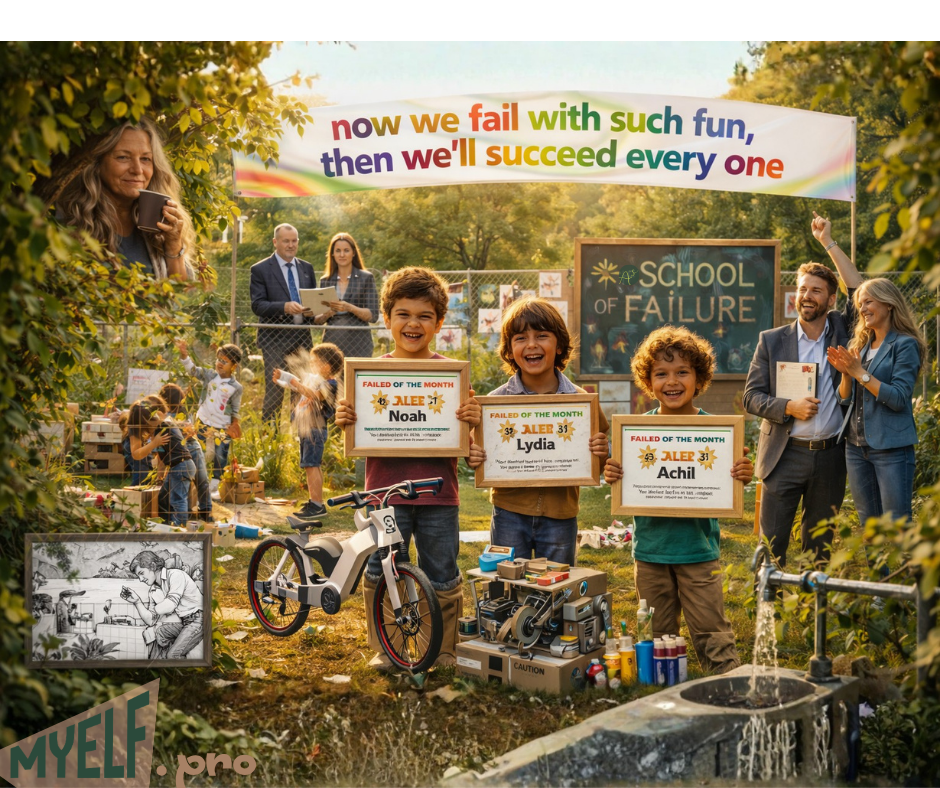
© 2026 MyElf pro - Second attempt at creating a visual based on this plot, with a more detailed prompt - still just not too bad.
This text (visuals) will be updated as soon as I find the calm to work on the prompt. If you don’t want to miss it, please keep an eye on my wall on LinkedIn.
Failure in French = échec (n.) — from game to condition
From Old French eschec, derived from Persian shāh (“king”), as in “the king is in danger” (see Chess).In its original sense, échec does not end the game; it marks a position of exposure that demands response.
Only échec et mat—from Persian shāh māt, “the king is helpless”—signals the end.
By extension, modern French uses échec for “failure,” though its origin suggests something far more dynamic: not defeat, but a state of pressure in which movement is still possible. Failure, in this sense, is the moment the game becomes undeniable and cannot be ignored, dismissed, or argued away.